Logged into your dashboard after a big campaign, only to see your authorization rate slip from 88% to 85%?
That dip might look small on a weekly chart. But it can quietly translate into thousands of dollars in lost revenue within a few hours of traffic hitting that PSP.
Worldpay notes that a mere 1% drop in authorization rate can mean millions in annual lost revenue at scale, while Stripe reports large businesses can capture millions more in additional revenue each year from just a 0.5% improvement.
The reality is, payment performance rarely breaks overnight. Small deviations in authorization rates, spikes in fees, or subtle shifts in decline codes tend to go unnoticed. Until the month-end report lands like a punch to the gut, showing exactly how much revenue has leaked out.
What Anomaly Detection Means in a Payments Context
To a payments leader, an anomaly is any deviation from the expected baseline that signals a leak in your revenue engine.
It’s not always a hard failure. More often, it’s a subtle shift that compounds quietly until it shows up in your numbers.
These can surface in different ways:
Temporal Velocity: Anomalies can be sudden spikes, such as a surge in gateway timeouts in one region; or gradual “drifts” where authorization rates slip by a few basis points each day over two weeks.
Granular Attributes: Issues rarely hit your entire stack. More often, they’re isolated to a specific slice: a single issuer cluster, a card portfolio range, or one authentication flow behaving differently on a given processor in a particular market.
Economic vs. Operational: While you likely monitor authorization rates, anomalies also hide in your cost of acceptance. A shift in your interchange mix or a sudden surge in “scheme fee” line items can erode margins even if your top-line revenue looks healthy.
Anomalies are often localized. You might see an issue tied to one PSP, one country, one BIN range, or one card network, while everything else looks healthy.
Let’s say you’re scaling in Europe. Your aggregate authorization rate hasn’t changed by much, but deep in the data, your “Do Not Honor” codes for a secondary PSP in France have climbed from 2% to 7%. Perhaps pointing to upstream issuer or fraud-model friction.
Without AI intelligence, this problem would’ve remained invisible for longer than necessary. Causing you to over-pay for retries, while losing high-intent customers at the final hurdle.
Effective anomaly detection helps you catch these early, while you still have room to reroute and investigate.
The Blind Spots of Traditional Payment Analytics
Traditional payment analytics keep you in hindsight mode. Your dashboard shows an authorization dip, but it’s still up to you to uncover where it started, what triggered it, and why it’s happening.
By the time you start digging, the revenue leak is already underway. Forcing you to play detective, manually slicing data by currency, BIN, and processor to pinpoint the source.
You pull reports by PSP, then by country, then by decline code, then by card type, hoping the pattern shows up. Meanwhile, the real issue may be hiding in the intersections.
For example, let’s say your overall approval rate looks stable, but Visa credit transactions in Spain are failing only on one secondary processor, after a routing change. A static dashboard will not be able to flag that combination.
Effective anomaly detection requires connecting multiple signals at once across providers, regions, methods, issuers, and cost drivers. That’s where smarter intelligence becomes essential.
How Machine Learning Improves Anomaly Detection
To catch anomalies early, you need more than charts. You need models that understand what “normal” looks like across your entire payment stack.
Machine learning improves detection because it can:
Learn expected ranges automatically
It builds confidence intervals for approval rates, latency, decline codes, and fee levels, so you know when a change is statistically meaningful.Monitor thousands of combinations at once
Humans can’t manually track patterns across PSPs, regions, BIN ranges, payment methods, authentication flows, and issuer behavior simultaneously.Forecast what should happen next
Models predict baseline performance, so a quiet drift is flagged before it becomes an outage.Use multiple models for different KPIs
Authorization health, routing performance, cost of acceptance, and fraud friction each require separate detection logic.Surface actionable alerts instead of raw data
Instead of digging through reports, you get a clear signal: “Mastercard debit approvals dropped 4% in Brazil on PSP B, costing an estimated $18K today.”
While a human analyst can track a few KPIs, AI monitors thousands of pattern combinations simultaneously to establish precise confidence intervals for your unique traffic. The outcome is faster response, less manual investigation, and fewer revenue leaks hiding in plain sight.
From Theory to Practice: Detecting Anomalies Across Multiple KPIs
In a complex global stack, payment issues will rarely show up as a single clean metric drop. What looks like a small acceptance dip on your dashboard? It’s usually connected to multiple shifts happening at once.
For example, a 2% decline in approval rate might coincide with:
A spike in “Do Not Honor” responses from one issuer cluster
Higher soft declines after a 3DS rule change
A sudden increase in scheme fees on a specific card network
Latency creeping up only on your secondary PSP in one region
If you only monitor authorization rate in isolation, you’ll miss the actual story.
Example scenario: A 3% drop in conversion for recurring payments in North America. A basic dashboard will show the dip. But multi-KPI analysis might reveal that Visa Debit transactions are seeing a 12% spike in “Do Not Honor” codes, specifically on your secondary processor.
By correlating card brand, transaction type, and processor response codes, you can identify a misconfigured routing rule before it impacts your primary volume.
This holistic approach allows you to compare dimensions instantly, identifying exactly where performance deviates from the norm. This is the foundation of how modern payment intelligence platforms like IXOPAY approach anomaly detection with the AI Payments Intelligence product. By turning fragmented data points into a clear, actionable diagnostic.
How IXOPAY Applies This in Practice
IXOPAY brings anomaly detection into your daily payments workflow. Inside the “detected anomalies” view, you get a clear list of issues ranked by severity, so you immediately see what needs attention.
For example, if your Successful Authorizations Rate drops, the platform highlights the impact in real terms: current revenue loss, projected annual exposure, and affected transactions.
You’re not guessing whether a 3% dip matters. You can quantify its impact.
With Anomaly Explorer, you can drill into specific patterns like one gateway, one payment method, and one country. The model then flags whether that exact slice is behaving outside its baseline.
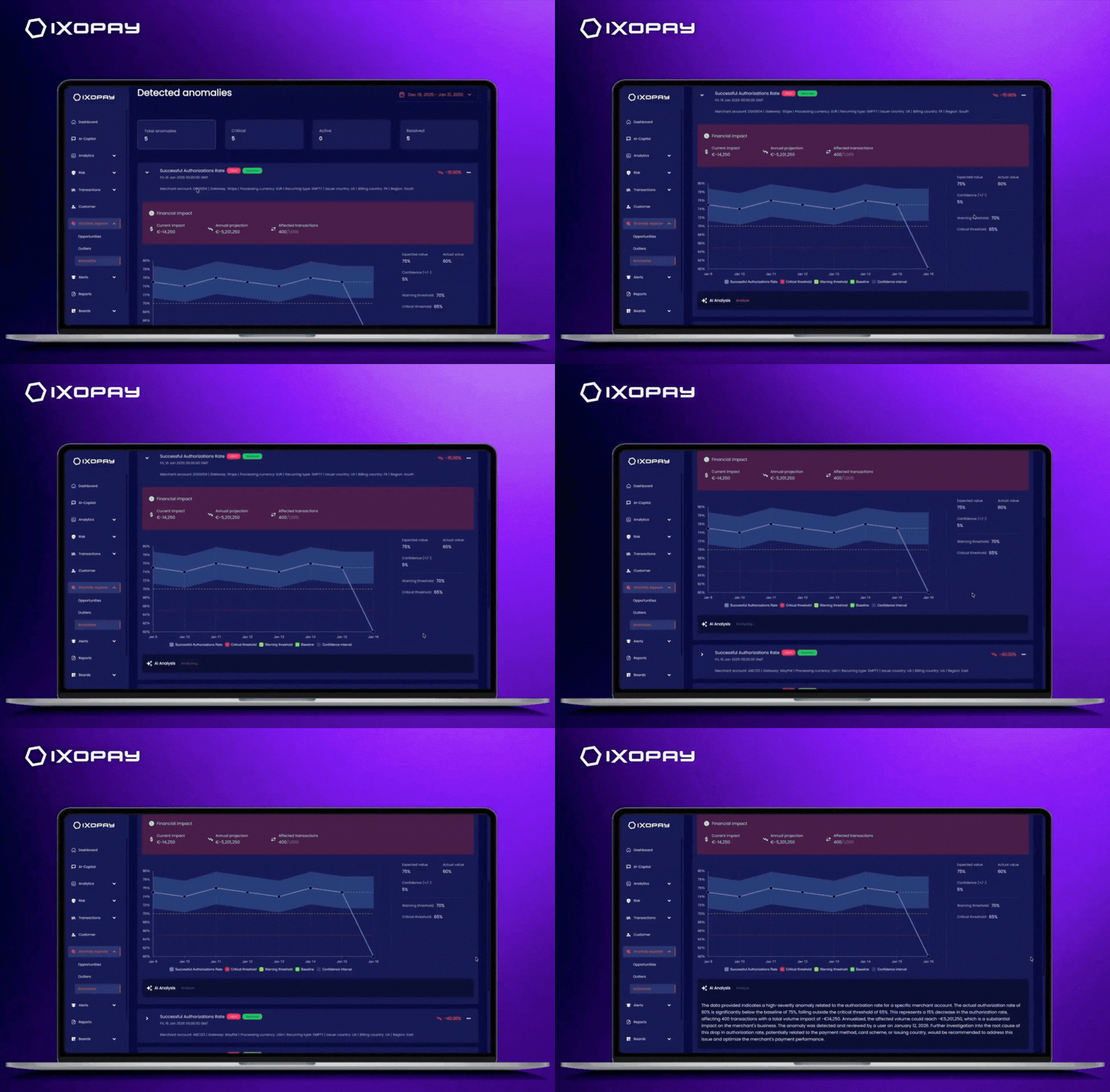
You can also define alerts, such as “Successful Authorizations Rate > 75,” and route notifications through Slack or other channels. So that payment issues can be addressed before they become outages.
Concluding Note: From Detection to Action
Catching anomalies is only valuable if you can act before revenue leaks start compounding.
With AI-driven payment intelligence, detection becomes part of how you run payments every day, not something you review after month-end.
When anomalies surface early, you can:
Respond faster to authorization drops, latency spikes, or fee surges
Spend less time slicing reports and more time optimizing routing and retries
Align payments, finance, and product teams around the same impact signals
The outcome is practical:
Protect revenue during peak volume and expansion pushes
Control cost of acceptance as your provider mix grows
Scale confidently across PSPs, markets, and payment methods
In complex global stacks, anomaly detection is a prerequisite for operational control.
Book a demo now to see how IXOPAY can help you detect and act on payment anomalies before they impact revenue.
