TL;DR
AI agents are becoming a genuine emerging sales channel, but nobody knows yet which assistants, marketplaces, or protocols will define it.
Building a separate payment integration for every new agent or standard is neither practical nor scalable.
The IXOPAY Agentic Suite gives merchants three things: the Universal Token (a portable, auditable record of who authorized what), the Payment Agent (one integration to connect supported agentic channels), and the MCP Server (governed AI access for payment and development teams).
It works with the PSPs, acquirers, gateways, and orchestration merchants already use. Nothing needs replacing.
It is also the first step toward something bigger: fluid commerce — payment infrastructure that adapts as fast as the market moves.
AI agents are changing how customers discover, compare, and purchase products. Merchant-owned shopping assistants, answer engines, and AI marketplaces are creating new customer journeys and opening agentic commerce as an emerging sales channel.
For merchants, however, the opportunity comes with a practical challenge.
The future of commerce will not be defined by a single AI assistant, platform, or protocol. It will be an evolving ecosystem of intelligent agents working across different channels. Building and maintaining a separate payment integration for every new agent or standard is neither practical nor scalable. Merchants don't need another point integration. They need commerce infrastructure that stays fluid — able to connect, adapt, and expand as fast as the market changes around it.
That is why we are introducing the IXOPAY Agentic Suite: a flexible, future-ready foundation that helps merchants participate in agentic commerce while preserving control over their payment infrastructure.
The suite brings together three capabilities:
The Universal Token, now enhanced with data points such as agent identity, customer consent, and purchase intent. It creates a portable, auditable record of the trust behind an agent-initiated transaction, giving merchants stronger evidence for disputes and greater visibility and control over every transaction.
The Payment Agent, which connects supported AI shopping experiences to a merchant’s existing payment infrastructure through a single integration — or provides that shopping experience directly for merchants who don't have one — helping merchants enter new agentic commerce channels faster without rebuilding their payment stack for every new agent, platform, or protocol.
The MCP Server, which gives authorized AI assistants secure, governed access to payment and tokenization capabilities, enabling teams to accelerate development and automate payment workflows while keeping credentials protected, permissions controlled, and AI actions auditable.
Together, these capabilities help merchants build, buy, and evolve their agentic commerce strategy without repeatedly rebuilding integrations or becoming locked into a single AI or payment ecosystem.
Agentic commerce requires a new trust model
In a traditional online transaction, merchants rely on a range of human signals to understand how and why a purchase occurred. When an AI agent acts on behalf of a customer, many of those signals may no longer be available.
If a transaction is later disputed, the merchant may need to answer several important questions:
Which agent performed the transaction? What did the customer authorize? Did the agent act within the agreed limits? What was the intent behind the purchase?
The IXOPAY Universal Token helps preserve that context.
Built on IXOPAY’s Universal Token, it securely links the payment reference with the trust artifacts associated with the transaction, including agent identity, customer consent, and purchase intent.
The result is a merchant-owned, auditable record that can provide stronger evidence during chargebacks, disputes, fraud investigations, and compliance reviews.
The Universal Token works alongside network tokens rather than replacing them. Network tokens continue to provide issuer-level trust and payment optimization, while the Universal Token gives merchants greater portability, policy control, and visibility into the agent’s authority and actions.
Merchants retain this transaction context as payment providers, AI platforms, channels, and protocols evolve.
One connection for an evolving agent ecosystem
AI-powered shopping can take different forms. A merchant may already have its own shopping agent, want to introduce a conversational shopping experience, or need to accept purchases initiated by third-party AI assistants.
The IXOPAY Payment Agent provides a consistent payment layer across these experiences, connecting agentic commerce channels to the merchant’s existing payment infrastructure through a single integration. Where a merchant has no shopping agent of its own, Payment Agent can provide that experience directly as well.
Merchants can use Payment Agent in three ways:
1. Connect an existing merchant-owned shopping agent
For merchants that have already built their own AI shopping experience, Payment Agent can handle the payment side of the journey.
Once a customer has discovered and selected a product, the merchant’s shopping agent sends the purchase request to Payment Agent. Payment Agent interprets the request, coordinates the required payment actions, and completes the transaction through the merchant’s existing payment infrastructure.
This allows merchants to add agentic payment capabilities to their own customer experience without building and maintaining separate payment logic for every supported protocol or provider.

2. Add an embedded AI shopping experience to the merchant website
Merchants without an existing shopping assistant can offer a conversational shopping experience through IXOPAY's embedded agent — Payment Agent itself, connected to the merchant's product catalog.
Here, Payment Agent handles the whole journey. It helps customers discover, compare, and select products, and when the customer is ready to buy, it accepts the purchase, coordinates the payment process, and routes the transaction to the appropriate downstream systems.
This gives merchants a path to launch an AI-assisted shopping experience without building their own agent or payment workflow from the ground up.

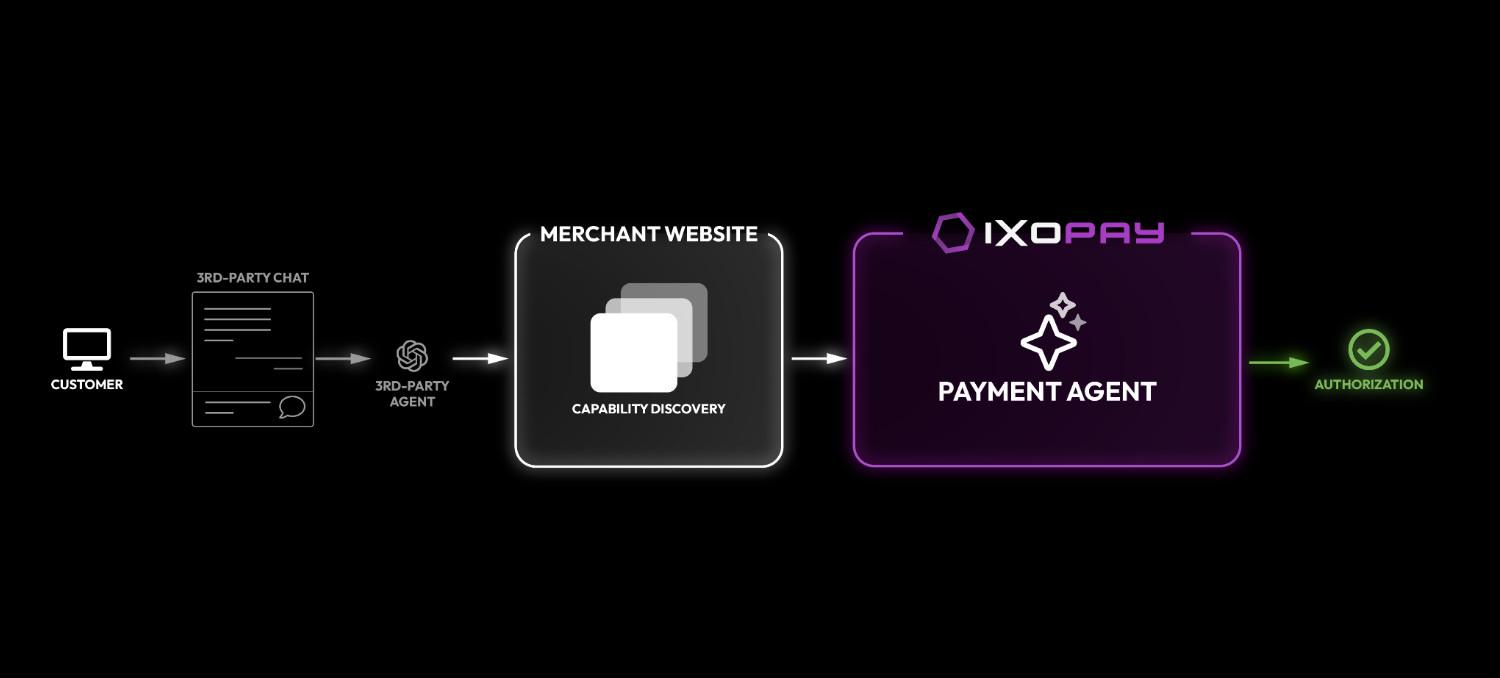
3. Accept purchases initiated by third-party AI agents
Payment Agent also enables merchants to participate in shopping journeys that begin outside their own website.
A customer might ask a supported third-party AI assistant or shopping platform to find and purchase a product. Once the merchant and product are selected, the third-party agent can send the purchase request to Payment Agent, which interprets the incoming request and coordinates the payment through the merchant’s existing infrastructure.
This gives merchants a way to extend their reach into emerging AI marketplaces and agent-driven commerce channels without creating a separate payment integration for each supported experience.
Across all three scenarios, Payment Agent acts as the merchant’s payment specialist for agentic commerce — coordinating elements such as tokenization, authentication, routing, and downstream processing as required.
Transactions can be routed through the IXOPAY Payment Orchestration Platform for intelligent routing, retries, and optimization, or passed to the merchant’s existing gateway or orchestration provider.
There is no requirement to replace existing PSPs, acquirers, gateways, or payment infrastructure. Merchants integrate once and gain a flexible foundation for supporting new agentic commerce experiences as the ecosystem evolves.
Secure, governed access for third-party agents
AI is not only changing the customer experience. It is also becoming part of how development, payment operations, and compliance teams work — a shift we unpack in what is agentic payment operations.
However, connecting agents from answer engines or AI assistants, like Claude or ChatGPT, directly to payment systems can introduce significant access and governance concerns. Credentials must remain protected, user permissions must be respected, and AI systems must not receive unrestricted access to sensitive payment data.
The IXOPAY MCP Server provides the control layer needed to manage that access, so payment teams can put AI to work without widening their risk surface.
Using the Model Context Protocol — an open, vendor-neutral standard adopted across the AI industry — the MCP Server enables approved AI assistants to perform supported payment and tokenization tasks while acting as a policy enforcement layer between the AI client and IXOPAY’s capabilities.
Before an action is performed, the MCP Server verifies the authorizing user and evaluates the request against that user’s existing permissions, authorized vaults, and available capabilities.
API keys and other sensitive credentials remain isolated from the AI client. Agents cannot exceed the permissions of the person who authorized them, and actions are logged and tied back to that user for traceability.
This gives development and operations teams a governed way to use conversational AI for supported tokenization and payment-data workflows — accelerating development and automating repetitive tasks without weakening existing security controls.
For a closer look at where this is heading — the use cases, the data and governance challenges, and what payment operations could look like by 2030 — read our whitepaper, The Future of Agentic Payment Operations.
Built for merchant choice and control
Agentic commerce is still evolving. New assistants, protocols, and customer experiences will continue to emerge, and no single platform is likely to define the entire ecosystem.
Merchants therefore need more than a point solution. They need an infrastructure strategy that allows them to evolve.
The IXOPAY Agentic Commerce Suite gives merchants that foundation by combining:
Portable trust, so transaction context remains under the merchant’s control.
Interoperability without rebuilding, so merchants can plug into the agentic commerce channel using a single point of entry that works across shopping experiences, protocols, and providers.
Governed AI access, so teams can adopt AI-assisted workflows without exposing credentials or expanding permissions.
Most importantly, the suite works with the merchant’s existing payment infrastructure. It is designed to add the capabilities required for agentic commerce, not force merchants to replace the systems and provider relationships they already rely on.
This is what fluid commerce looks like in practice: new channels connected quickly, existing investments preserved, and control staying where it belongs.
Prepare for the next era of commerce
Agentic commerce represents a significant new opportunity for merchants, but preparing for it should not require betting on a single assistant, protocol, or proprietary ecosystem.
With the IXOPAY Agentic Suite, merchants can establish a flexible foundation for agentic commerce, supporting new customer journeys while retaining ownership, portability, security, and control.
Agentic commerce is not the first place merchants have felt the need for infrastructure that moves as fast as the market does, and it will not be the last. The Agentic Commerce Suite is another milestone marketing the broader shift in how we are building for fluid commerce, and we will have more to share on that soon.
